
The Emerging Regulatory Wave on Dark Patterns: A Disruption Across Digital and Consumer Industries
Regulation targeting manipulative user interface (UI) designs, commonly known as "dark patterns," is gaining momentum beyond academic critique into formal policymaking. This weak signal suggests a potential widespread disruption in how digital products engage consumers and manage data privacy. Governments across multiple jurisdictions are poised to tighten rules, increasing compliance complexity, and prompting industries to rethink UX strategies to avoid penalties and reputational damage.
What's Changing?
Dark patterns are UI/UX design techniques that deliberately manipulate users into actions they might not otherwise take, affecting informed consent and privacy. Initially a niche focus within digital ethics, dark patterns are now attracting regulatory scrutiny from U.S. states such as Washington and the federal government, signaling a shift towards enforceable legal standards (Bloomberg Law).
This momentum aligns with broader trends in consumer data protection and digital rights, as multiple states gear up for coordinated investigations into violations related to misleading design practices (Baker & Hostetler LLP). The regulatory approach is expected to move from advisory guidelines to binding obligations, including possible sanctions and fines potentially amounting to significant percentages of global revenues.
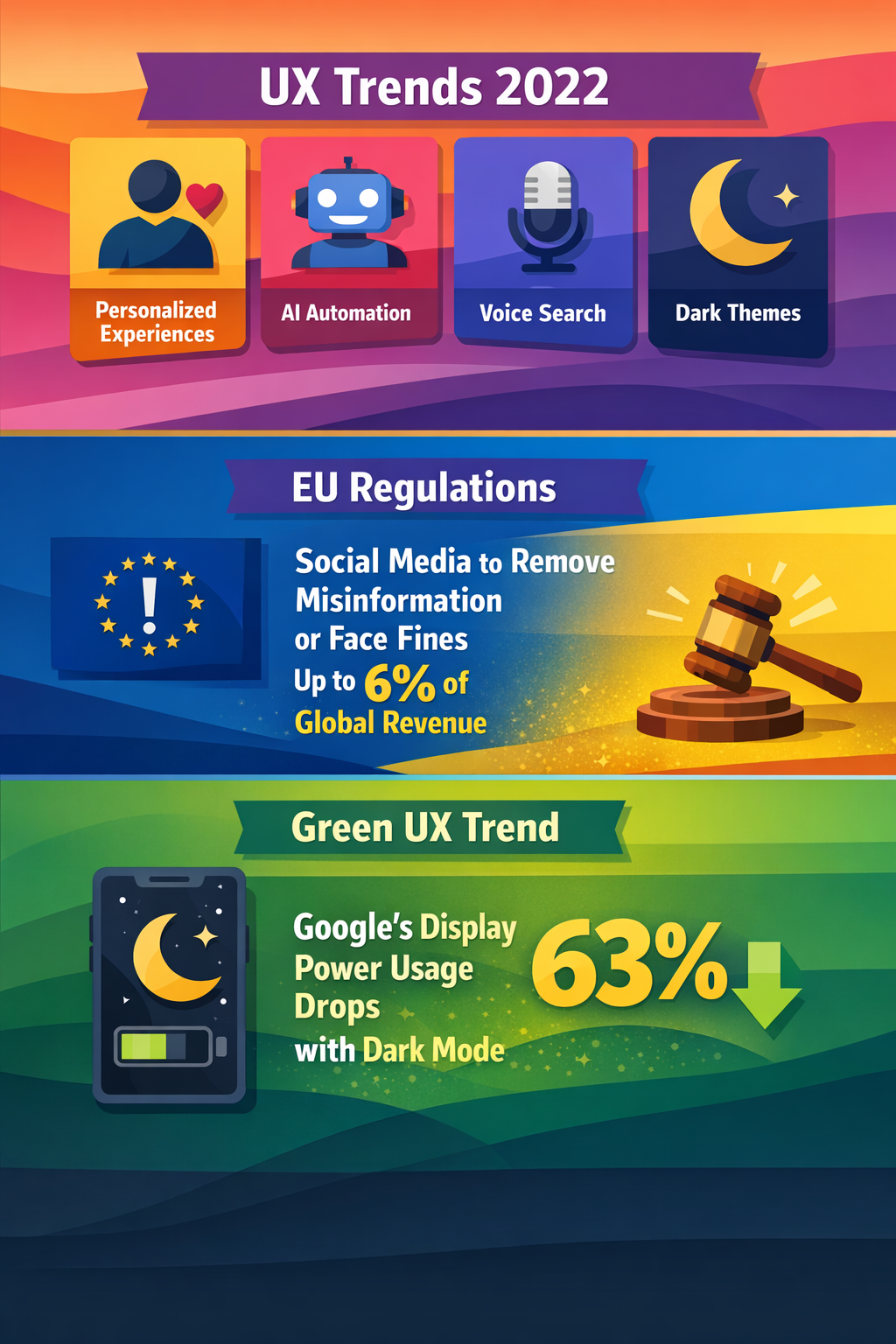
Concurrently, regulatory bodies in the European Union and the United States are cooperating to alter incentive mechanisms on major Internet platforms. This aims to combat the spread of misinformation and manipulative content through algorithmic design choices tied closely to user engagement metrics (Politico; GMFUS).
Moreover, the nexus of UX design trends with sustainability and energy efficiency, such as "dark mode" interfaces which reduce power consumption, interplays interestingly with ethical design. This intersection may broaden regulators' lens as design choices increasingly impact not just behavioral outcomes but also environmental footprints (Inkbot Design).
These developments collectively represent a systemic evolution where manipulative design practices are no longer tacitly accepted industry norms but risk becoming liabilities. This regulatory shift may extend beyond tech firms to sectors dependent on digital customer interfaces, including financial services, healthcare, and retail.
Why is this Important?
The growing regulatory focus on dark patterns reflects an urgent need to uphold consumer autonomy, fairness, and data privacy in an era of complex digital ecosystems. Malpractices in UI design not only erode trust but also potentially facilitate unlawful data harvesting and deceptive commercial practices.
Industries may face rising legal risks and compliance costs as enforcement converges across jurisdictions, given the trend towards coordinated inquiries and harmonized regulatory approaches (Baker & Hostetler LLP). Failure to preemptively address embedded dark patterns could result in substantial fines and damage to brand reputation, especially in competitive sectors with direct consumer interfaces.
Furthermore, changing algorithms on digital platforms to reduce engagement with false or manipulative content may disrupt longstanding digital marketing and advertising models, affecting revenue streams for content publishers and platforms alike (Politico).
On a societal level, mitigating manipulative digital experiences may foster healthier online environments, increasing democratic participation and reducing misinformation dissemination (GMFUS).
Implications
Companies across sectors must proactively audit UI/UX designs to identify and eliminate dark patterns before regulation mandates it. This requires:
- Cross-functional collaboration between legal, compliance, design, and engineering teams to understand emerging rules and ensure adherence.
- Investment in transparency and user-centric design principles that prioritize informed, ethical choice architectures.
- Adaptation of business models to reduce dependency on manipulative engagement metrics, necessitating innovation in customer experience and value creation.
- Continuous monitoring of evolving regulatory landscapes, including multi-jurisdictional enforcement trends and international cooperation frameworks.
Policymakers may also expand their scope to integrate sustainability concerns into UI design oversight, potentially incentivizing designs that combine ethical engagement with environmental benefits, as green UX gains traction. Such convergence could broaden compliance burdens but also open new avenues for brand differentiation and consumer goodwill.
For platform operators and social media companies, algorithmic transparency and incentive realignment will be critical to maintain public trust and avoid restrictive sanctions. This could drive a transformation toward more democratic design, where user autonomy and information integrity are enhanced.
Governments and regulators stand to benefit by coordinating efforts internationally to close regulatory arbitrage opportunities and create clearer standards. However, striking a balance between oversight and innovation will remain a challenge, especially when addressing complex, evolving digital behaviors.
Questions
- How can organizations identify latent dark patterns embedded in legacy systems or unintentional design choices?
- What mechanisms can be developed to test and certify ethically compliant UI/UX at scale?
- How might emerging regulations influence the evolution of AI-driven personalization and automation in user interfaces?
- Could integration of sustainability metrics into UX design guidelines become a regulatory expectation? If so, how should organizations prepare?
- What opportunities exist for industries not traditionally subject to digital regulation to lead in ethical UI design?
- How might coordinated international regulatory frameworks impact global digital platform strategies?
- How can companies balance engagement-driven revenue models against the risk of regulatory fines and eroding consumer trust?
Keywords
dark patterns; user interface design; data privacy regulation; algorithmic transparency; ethical UX; sustainable web design; consumer protection
Bibliography
- Dark patterns in consumer data privacy garner policy attention. Bloomberg Law. https://news.bloomberglaw.com/tech-and-telecom-law/dark-patterns-in-consumer-data-privacy-garner-policy-attention
- What’s On the Horizon 2026? Data Privacy Trends That Will Redefine Compliance. Baker & Hostetler LLP. https://www.bsk.com/news-events-videos/what-39-s-on-the-horizon-2026-data-privacy-trends-that-will-redefine-compliance
- Politico Digital Bridge – targeting algorithms and policy primer. Politico. https://www.politico.eu/newsletter/digital-bridge/politico-digital-bridge-targeting-algorithms-us-policy-primer-franco-american-ai-spat/
- Thirteen point plan to launch a new and improved transatlantic alliance. GMFUS. https://www.gmfus.org/blog/2021/01/26/thirteen-point-plan-launch-new-and-improved-transatlantic-alliance
- Sustainable web design: Why dark mode UX is trending green. Inkbot Design. https://inkbotdesign.com/sustainable-web-design/