
The Hidden Inflection: Militarization of AI Supply Chains as a Vector in the Weaponisation of Everything
As autonomous systems and military artificial intelligence (AI) budgets surge, an under-recognized inflection is emerging in the weaponisation landscape: the militarization of AI supply chains. This development extends the “weaponisation of everything” beyond platforms and doctrines, embedding strategic vulnerabilities and influence deep into technology sourcing and industrial ecosystems.
This paper surfaces why the military AI supply chain militarization qualifies as a structural inflection with medium to high plausibility over the next 5–10 years. It highlights how supply chain governance, capital allocation, and industrial strategy could shift as defense AI spending outpaces civilian sectors, creating new regulatory and competitive imperatives. This perspective moves beyond platform-centric narratives to expose cascading effects that could reshape global defence-industrial complex architectures and regulatory schemas.
Signal Identification
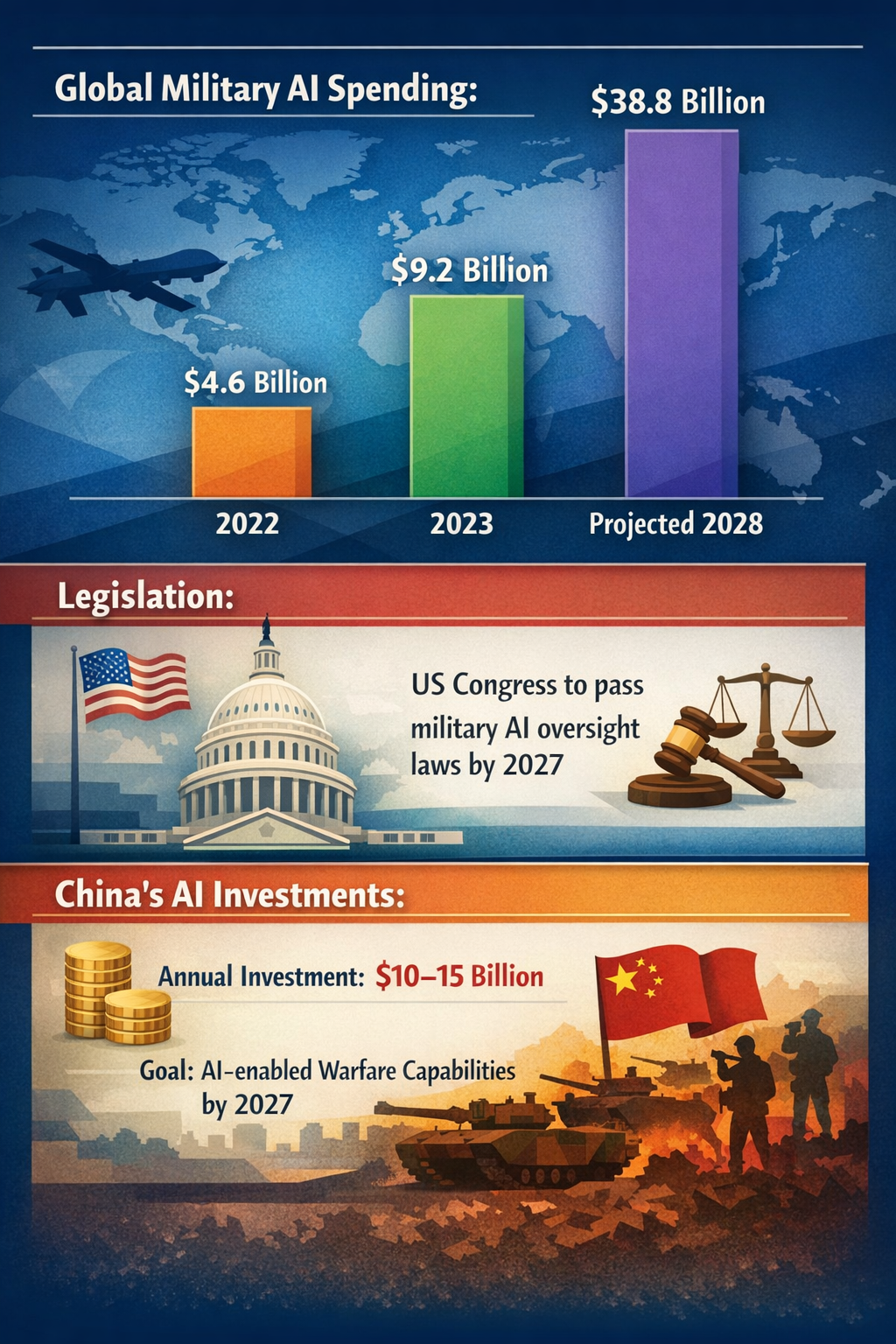
This development is classified as an emerging inflection. While military AI advancements and spending (projected to reach $38.8 billion by 2028) are widely tracked (The Defense Watch 12/04/2026), the deep strategic implications of militarized supply chains for AI components and software ecosystems remain underappreciated.
The plausibility band is medium to high given current procurement trends, legislative attention to AI oversight, and industrial prioritization of defense-grade AI systems (Tech Insider 15/03/2026). Time horizon is approximately 5–10 years, as regulatory frameworks (e.g., U.S. military AI oversight legislation by 2027) and investment volumes mature.
Exposed sectors include defense manufacturing, semiconductor and AI software supply chains, venture capital allocation, regulatory frameworks, and national security policymaking domains.
What Is Changing
Defense budgets are doubling for AI-focused spending, doubling from $4.6 billion in 2022 to $9.2 billion in 2023, with an aggressive growth trajectory expected to nearly quadruple by 2028 (The Defense Watch 12/04/2026). This infusion is not simply buying new weapons; it is incentivizing a reconfiguration of the AI technology base to comply with stringent military-grade standards and security protocols.
Moreover, the U.S. Congress is on track to pass dedicated military AI oversight legislation by 2027, fostering governance models that may impose compliance layers and auditability obligations unprecedented in civilian AI development (Tech Insider 15/03/2026). This trajectory encourages the segmentation of AI supply chains into “trusted” and “untrusted” categories, privileging closed, defensible ecosystems for defense applications.
While autonomous weapon systems and drone warfare innovations dominate headlines, the overlooked systemic shift relates to cyber warfare and intelligence competition’s persistent escalation, even absent open conflict (STL News 11/05/2026). This cyber front requires resilient, secure supply chains impervious to infiltration or degradation—pushing defense contractors and technology providers to internalize heightened supply chain controls and provenance tracking.
Additionally, misinterpretations of battlefield AI lessons, such as in Ukraine’s drone warfare, risk doctrinal miscalculations but also obscure the evolving focus on supply chain criticality. The strategic advantage increasingly hinges on access to trustworthy AI components, including proprietary algorithms, specialized hardware, and data services, rather than mere fielded systems alone (Harding Project 06/05/2026).
Collectively, these indicate a subtle but systemic evolution: the weaponisation of AI supply chains is not just an adjunct but a core battleground with implications for industrial structure, capital flows, and regulatory regimes.
Disruption Pathway
This inflection could scale structurally through sequential and reinforcing dynamics. Accelerated by rising global tensions and the AI arms race, demand for “defense-certified” AI products and secure components will intensify, prompting suppliers to segregate production lines or entire operations to comply with military standards.
This bifurcation will stress existing industrial ecosystems that have operated primarily on commercial openness and cost efficiency, generating supply chain bottlenecks for dual-use technologies. Noncompliance risks exclusion from lucrative defense contracts, incentivizing major technology players to invest selectively in “trust zones” or military innovation clusters.
As these segregated supply chains grow, a feedback loop may emerge where defense-oriented AI R&D pipelines diverge from civilian paths, accelerating technological specializations that reduce interoperability but increase national security assurances.
On the governance side, new legislation such as the expected 2027 AI oversight law will compel firms to increase transparency, provenance tracking, and audit trail maintenance within these supply chains, further raising barriers to entry and consolidating incumbents aligned with defense priorities.
Consequently, capital allocation will increasingly favor firms with dual-use credibility or explicit military partnerships, reshaping venture capital priorities and potentially driving consolidation in AI hardware and software markets. Sovereign industrial strategies will embed supply chain sovereignty as a central aim, catalyzing policies promoting onshoring or nearshoring of critical components.
Unintended consequences may include accelerated technological fragmentation of global AI ecosystems, complicating international cooperation on cybersecurity or arms control. Additionally, civilian sectors may face supply constraints and cost inflation, as defense-grade demands divert capacity.
Dominant industry configurations could transition from broad commercial platforms serving global markets towards segmented “trusted” AI ecosystems anchored in national security interests and regulatory frameworks, challenging existing global supply chain paradigms.
Why This Matters
For capital allocation, investors must reassess risk and opportunity profiles of AI startups and component suppliers vis-à-vis their military AI engagement and compliance capabilities. Firms lagging military certification may face market exclusion or devaluation.
Regulators will need to expand beyond use-case oversight to include supply chain integrity frameworks that integrate cybersecurity, industrial policy, and export controls. This necessitates new institutional capacities to audit and certify AI supply chains end-to-end.
For industrial strategy and supply chain resilience, governments and defense contractors must strategize beyond platform procurement to securing entire value chains. This evolution may inspire national mandates on sourcing, incentivize domestic production of semiconductors and AI software frameworks, and precipitate realignment in allied supply networks.
Liability models could shift as provenance and trustworthiness become criteria in AI system deployment, introducing new legal and compliance risks for firms in defense-linked supply chains.
From a governance standpoint, this reorientation could strain international control regimes and complicate arms control negotiations by embedding AI-related vulnerabilities across disparate industrial sectors.
Implications
This development could plausibly catalyze structural change by redefining the contours of defense-industrial ecosystems, separating military AI supply chains from commercial innovation pathways. This dual ecosystem scenario may materialize within the next decade as regulatory, investment, and strategic realignments take effect.
The signal is not simply an incremental increase in AI military budgets or autonomous weapons proliferation, but the systemic militarization of foundational technology supply controls, which could entrench techno-nationalistic fragmentation.
This also differentiates from hype around autonomous system capabilities alone; instead, it spotlights under-the-radar industrial and regulatory shifts with longer timeframes and broader impacts.
Competing interpretations might argue the military AI supply chain remains tightly linked to civilian markets or that openness will prevail due to innovation benefits, but growing legislative oversight and national security pressures suggest a bifurcating dynamic.
Early Indicators to Monitor
- Record or surge in procurement contracts specifying defense-grade AI components and supply chain provenance metrics.
- Legislative progress on AI supply chain oversight and auditing standards, including compliance deadlines related to the 2027 military AI oversight law.
- Venture capital trends showing clustering around “trusted” AI startups with defense partnership credentials.
- Patent filings emphasizing AI hardware/software security features specific to defense applications.
- Announcements of industrial policy shifts prioritizing onshoring or strategic stockpiling of AI-critical materials and technologies.
Disconfirming Signals
- Failure or significant delay in passing AI military supply chain oversight legislation by 2027.
- Demonstrable convergence of civilian and military AI platforms without supply chain segregation or trust frameworks.
- Major defense contractors publicly rejecting segmented supply chains in favor of open commercial sourcing models.
- Reduction or plateauing of military AI procurement budgets that limits the scale of specialized supply chain demand.
- Emergence of dominant civilian AI ecosystems that fully comply with military standards without structural bifurcation.
Strategic Questions
- How should capital deployment strategies adapt to emerging bifurcations in AI supply chains driven by defense certification and provenance requirements?
- What regulatory frameworks and institutional capacities are required to govern militarized AI supply chains effectively without stifling innovation?
Keywords
military AI; AI supply chain; autonomous weapons; military AI oversight; defense industrial strategy; cyber warfare; dual-use technology; venture capital AI
Bibliography
- The Military AI market's foremost strength lies in advanced technological capabilities, such as autonomous weapon systems that enhance defence precision and reduce human risk, providing a competitive edge in global defence strategies. The Niche Research. Published 18/01/2026.
- Challenges prevailing narratives about drone warfare, arguing that misreading Ukraine's lessons risks catastrophic tactical and doctrinal miscalculation. Harding Project. Published 06/05/2026.
- Cyber warfare between regional powers and global intelligence agencies will likely continue even if open military conflict slows. STL News. Published 11/05/2026.
- Global military AI spending is estimated to have doubled from $4.6 billion to $9.2 billion between 2022 and 2023, and is projected to reach $38.8 billion by 2028. The Defense Watch. Published 12/04/2026.
- Congress will pass military AI oversight legislation by 2027. Tech Insider. Published 15/03/2026.