
Unveiling the Impact of Oral Small-Molecule GLP-1 Receptor Agonists: A Hidden Inflection in the Future of Diet Drugs
The emergence of oral small-molecule GLP-1 receptor agonists (RAs) signals a transformational shift in obesity and metabolic disease treatment that remains underappreciated. While much attention centers on injectable GLP-1 biologics like Wegovy, the scalability, accessibility, and systemic disruption potential of oral formulations with low manufacturing complexity is a crucial weak signal with far-reaching consequences. This paper explores how this development could reshape capital flows, regulatory landscapes, and industrial structures over the next 10–20 years.
Signal Identification
This development qualifies as a weak signal coupled with emerging inflection: oral small-molecule GLP-1 RAs are presently in early clinical and regulatory stages, but they possess high plausibility of triggering systemic change within a 10 to 20-year horizon. Their disruptive potential lies not just in clinical efficacy but in fundamentally altering access, cost structures, and supply chains in obesity management. Key sectors exposed include pharmaceutical manufacturing, healthcare delivery, insurance and reimbursement frameworks, food and beverage industries, and public health governance.
What Is Changing
Across multiple sources, a recurring yet underappreciated theme emerges: the transition from biologic injectable GLP-1 medications toward orally available small molecules (e.g., aleniglipron) could overcome cost, storage, and scalability barriers that currently inhibit broad international access (Nature Medicine 29/04/2026; Yahoo Finance 26/05/2026).
Presently, injectable GLP-1 analogs like Wegovy dominate US weight-loss drug prescriptions but rely on complex manufacturing and high pricing models. The anticipated US launch of less expensive orally active agents with simpler manufacturing and storage needs could democratize access globally, reshaping healthcare system priorities toward obesity treatment (PMC 12/03/2026). This is especially salient as generic biologics accelerate adoption in developed countries and emerging markets, creating multifactorial pressure on pricing and reimbursement strategies (Peptides Explorer 15/04/2026).
Novel research suggests GLP-1’s broader physiological benefits—such as testosterone and sperm quality enhancement in men with obesity—indicate the class’s potential to recalibrate clinical risk-benefit assessments and prescribing norms beyond traditional weight management (Scientific American 03/05/2026). This unexpected axis furthers the systemic repositioning of GLP-1 drugs as multi-indication therapeutics.
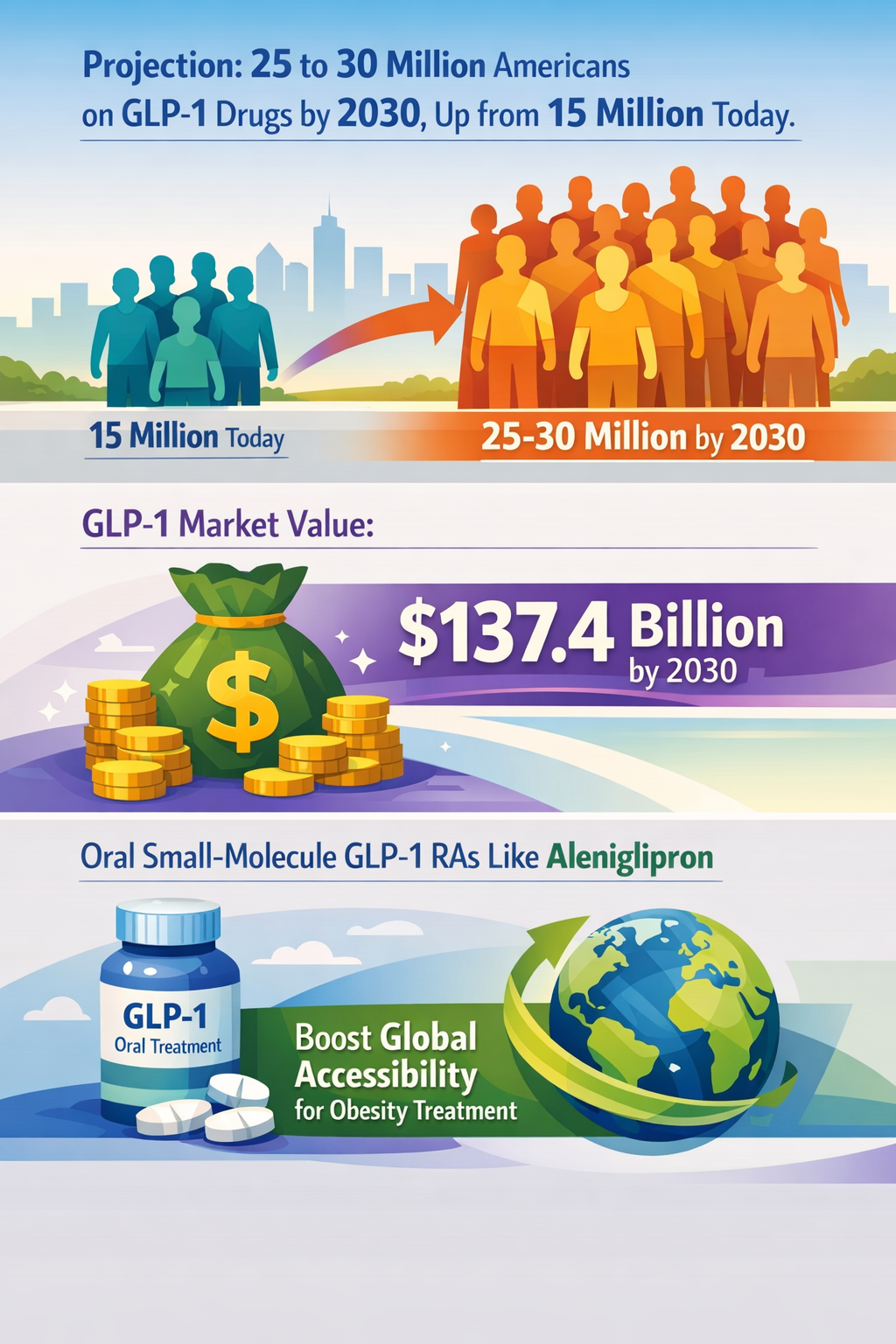
Simultaneously, estimates forecast that up to 30 million Americans might be on GLP-1 therapy by 2030, nearly doubling current figures, which intensifies demand for scalable, cost-efficient drug forms. Combined with potential price reductions of injectable products, oral small molecules stand to dramatically widen the user base, disrupting incumbent brands, pharmaceutical supply chains, and pricing regimes (Peptides Explorer 15/04/2026; Yahoo Finance 26/05/2026).
The food and beverage industry also faces substantial exposure, with projections anticipating GLP-1 adoption reducing discretionary food spending by $48–55 billion annually in the US alone over the next decade. This indirect economic pressure derives from appetite suppression and associated behavior changes that current narratives have yet to fully address (Clearcogs 10/05/2026).
Disruption Pathway
Oral small-molecule GLP-1 RAs could first gain regulatory approval based on demonstrated bioequivalence and long-term clinical benefits, triggering rapid payer uptake driven by cost advantages and ease of administration. Lower manufacturing costs and stable storage conditions will enable global distribution channels previously inaccessible to injectable biologics.
As broad access reduces treatment costs, public healthcare systems may deprioritize expensive bariatric surgeries and chronic obesity-related hospitalizations, reallocating budgets toward outpatient, pharmaceutical-driven management programs. Insurance providers could restructure formularies and reimbursement tiers reflecting shifting clinical guidelines backed by emerging longitudinal evidence. These adaptations will put pressure on incumbent GLP-1 manufacturers to innovate or risk commoditization amid price erosion.
In parallel, food and beverage sectors face demand contraction, forcing strategic repositioning toward healthier, reduced-calorie offerings or diversification away from impulse-heavy consumption models. This industry feedback may incentivize lobbying efforts targeting regulatory constraints on GLP-1 drug marketing and pricing.
Network effects among patients and clinicians will reinforce adoption momentum, as peer-to-peer information sharing lowers psychological and cultural barriers to medication acceptance. Health disparities may narrow if oral formulations penetrate underserved markets, especially in low- and middle-income countries.
The convergence of these forces could lead regulators to update frameworks emphasizing real-world effectiveness and longitudinal safety monitoring rather than only randomized controlled trial evidence, reflecting the complexity of obesity as a chronic disease. Institutional governance may evolve toward integrated metabolic health ecosystems blending medication, behavior, and environmental interventions.
Why This Matters
Strategic capital allocation must weigh the disruptive reconfiguration of pharmaceutical production toward adaptable, small-molecule synthesis platforms with broader manufacturing footprints. Investors and companies relying heavily on biologic GLP-1 blockbusters face margin compression and market share risk. Regulatory agencies should anticipate shifts in evidence requirements, patient support programs, and cross-sector collaborations between healthcare payers and food industries.
Legacy industrial actors in injectables, supply chain management, and clinical service delivery require proactive repositioning to avoid technological obsolescence and regulatory backlash. The opportunity exists to integrate oral GLP-1 molecules into preventative health models that may reduce chronic disease burdens and associated liability risks long-term.
Governments and public health bodies will confront pressure to revise obesity treatment frameworks and reimbursement policies, balancing short-term budget impacts against longer-term healthcare cost offsets and productivity gains.
Implications
Oral small-molecule GLP-1 receptor agonists could become a structural catalyst for democratizing obesity care globally and redefining pharmaceutical market dynamics. This signal likely indicates a transition to commoditized obesity therapeutics underpinned by diversified manufacturing and innovative delivery mechanisms. It might accelerate moves toward integrated, personalized metabolic disease management and real-world outcome-based regulatory environments.
This development is not mere hype around new diet drugs or a transient pricing war but suggests a deeper industrial shift affecting multiple adjacent sectors. Competing views might argue that safety concerns, long-term efficacy, or cultural resistance could impede adoption. However, mounting evidence and economic incentives make large-scale diffusion plausible.
Early Indicators to Monitor
- FDA and EMA filings and approvals for oral small-molecule GLP-1 receptor agonists
- Venture capital and pharmaceutical R&D investments in small-molecule GLP-1 candidates
- Emergence of generic oral obesity drug formulations and associated patent expirations
- Healthcare payer formulary revisions favoring oral GLP-1 drugs
- Shift in consumption patterns in food and beverage sector revenue correlated to GLP-1 drug adoption rates
Disconfirming Signals
- Failure of oral GLP-1 candidates to demonstrate long-term efficacy or safety in pivotal trials
- Regulatory restrictions or rejection based on novel safety signals or abuse potential
- Persistence of superior injectable biologics in efficacy or patient adherence metrics
- Significant cultural or behavioral resistance to oral treatments reducing market uptake
- Breakthrough alternative obesity treatments (e.g., gene therapy, microbiome-based) negating GLP-1 relevance
Strategic Questions
- How will pharmaceutical manufacturers reshape supply chains and production platforms to prioritize oral small-molecule GLP-1 RAs over biologics?
- What regulatory adaptations are necessary to balance accelerated access with robust real-world safety evidence for these novel oral obesity drugs?
Keywords
oral GLP-1 receptor agonists; scalability; obesity treatment; pharmaceutical supply chains; healthcare regulation; diet drugs; metabolic disease
Bibliography
- Nouvo's oral Wegovy captured 65% of new US prescriptions and generated $2.26 billion in Q1, but planned US price cuts of ~50% threaten margins. Yahoo Finance. Published 26/05/2026.
- GLP-1 adoption could reduce food-and-beverage spending by roughly $48 billion per year in its base case over the next decade, with higher-case estimates reaching $55 billion. Clearcogs. Published 10/05/2026.
- JPMorgan analysts project 25 to 30 million Americans will take GLP-1 drugs by 2030, up from roughly 15 million today. Peptides Explorer. Published 15/04/2026.
- As generics expand access and ongoing research clarifies long-term outcomes, healthcare systems will adapt to prioritise obesity treatment, ultimately improving population health and quality of life worldwide. PMC. Published 12/03/2026.
- The development of oral small-molecule GLP-1 RAs with lower manufacturing costs, simple storage conditions and greater manufacturing scalability, such as aleniglipron, could help expand access around the world for people with obesity or overweight. Nature Medicine. Published 29/04/2026.
- A systematic review presented today at the Endocrine Society's annual meeting in Chicago, Illinois, suggests that GLP-1 medications might increase testosterone levels and help to improve the quality of sperm in men with obesity. Scientific American. Published 03/05/2026.